
In 1973, two Forest Researchers determined that you could effectively scale down a wildlife habitat. National Wildlife Federation began their wildlife habitat education program, which reached me 30 years later (better late than never!).
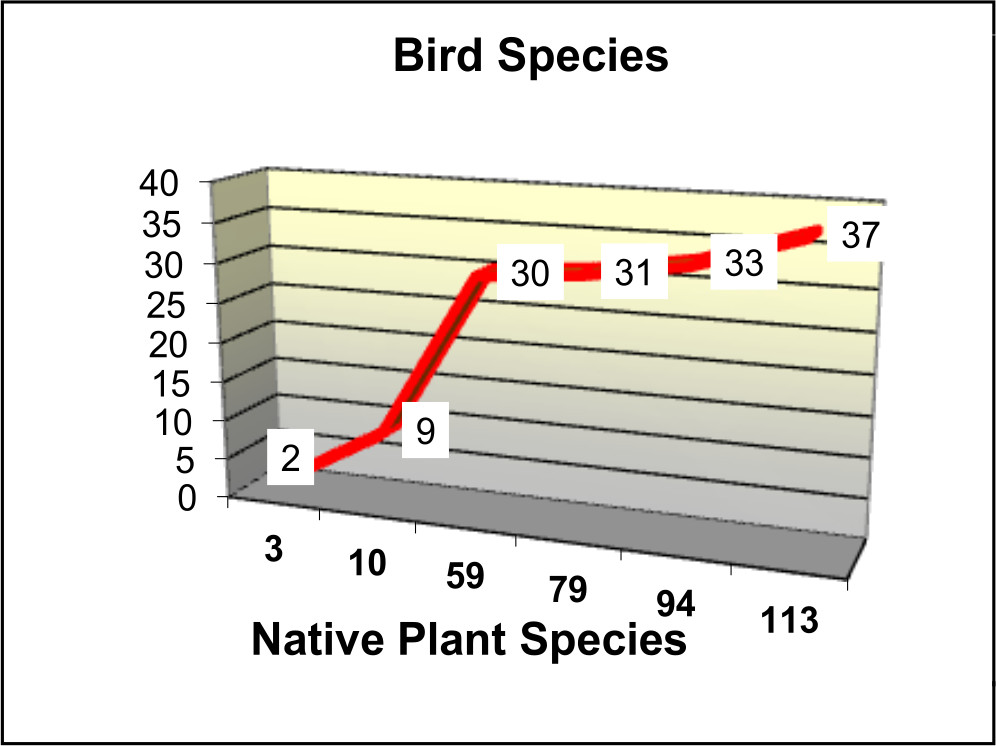
I have a postage-stamp sized yard in a typical city subdivision. By adding bird feeders and birdbaths, I only attracted 9 bird species. In 2003, I created a native forest edge in our backyard and eliminated chemicals.
The count jumped from 9 to 30 species in 12 different bird groups. A Cooper’s hawk showed up almost immediately. A migrating Ovenbird re-fueled here the next October on its way from arctic Canada to South America.
Create a Native Forest Edge
Go native: Native birds evolved to depend on native plants. They are easy to care for once established because they have adapted to our region. Traditional chemically treated lawns have little value to most native birds.
Only about 25% of bird species will use a bird feeder. I use baffle-protected feeders at different heights to bring birds out about 10-15 feet from cover where I can see them, and they are safe from hidden predators. I leave lots of leaf litter under our trees so there are insects for natural food.
To create a forest edge: I thought in vertical layers. Native plants at different heights with fruits and seeds ripening at different times will attract and help save the most species of birds. Native to the Ohio region are:
In the rear, plant canopy trees (i.e. Hackberry Celtis occidentalis or any native Oak tree) and sub-canopy trees (i.e. Common Chokecherry Prunus virginiana). Below, plant small, shade-tolerant trees (i.e. Nannyberry Viburnum Viburnum lentago and bushes (i.e. Spicebush, Lindera benzoin).
Then plant groundcover and vines that provide fruit (i.e. Virginia Creeper Parthenocissus quinquefolia). In the front of your forest edge, plant woodland plants (i.e. Woodland sunflower, Helianthus strumosus), native ferns (i.e. Cinnamon fern, Osmunda cinnamonea) and native herbs (i.e. Purple Coneflower Echinacea purpurea).
In sun: Plant evergreens like Eastern Red Cedar (Juniperus virginia) or Eastern Hemlock (Tsuga canadensis), native flowers (i.e. Black-eyed Susan, Rudbeckia fulgida) and grasses (i.e. Big Bluestem, Andropogon gerardii) and leave flowers and grasses standing until Mother’s Day. I watch birds eat plant seeds through spring.
Get Certified: Provide food, water, cover, places to raise young, practice sustainable gardening, and National Wildlife Federation will certify your yard as a Wildlife Habitat. Displaying their sign helps others understand what I am doing. See www.nwf.org/certify.